
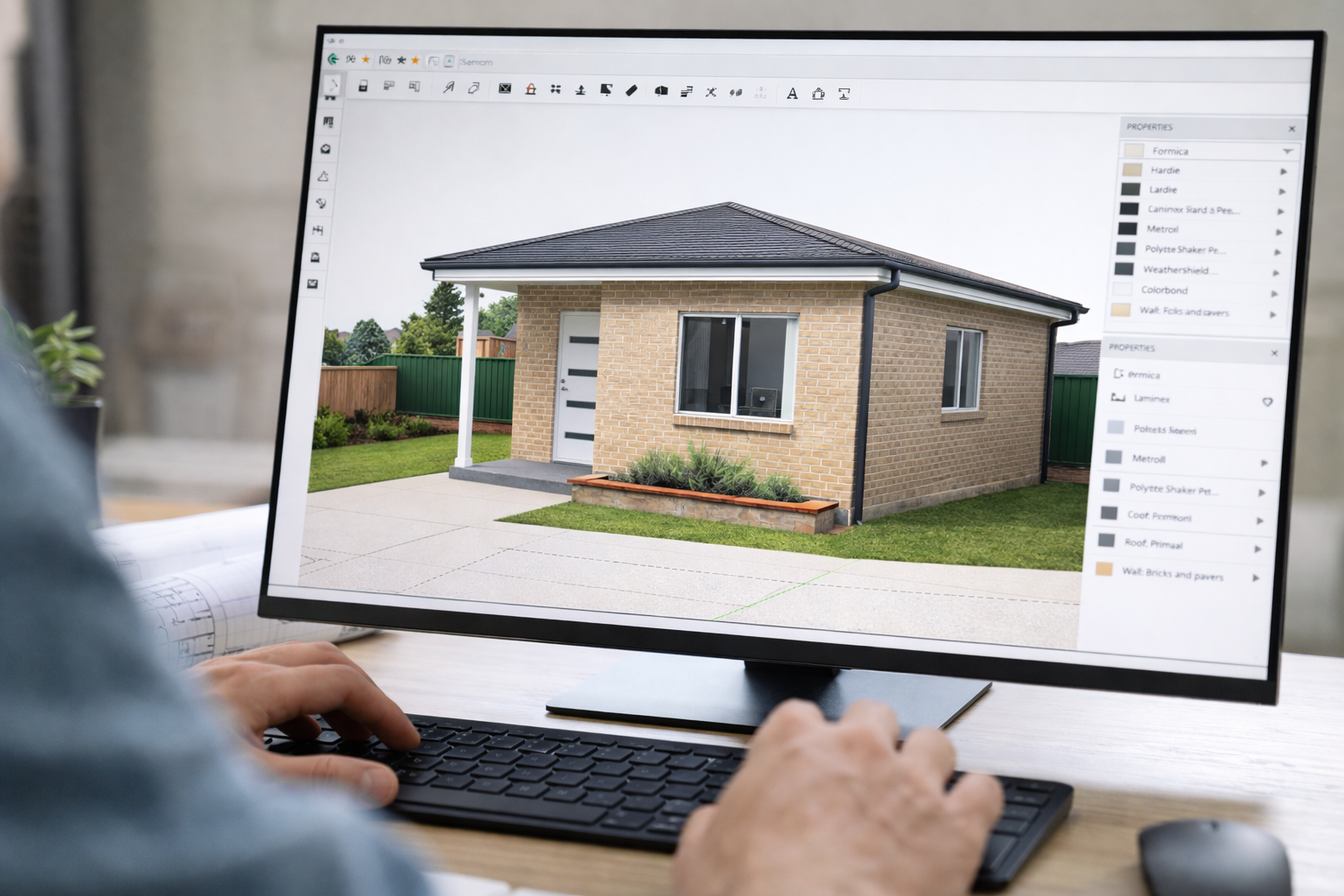
For most homeowners, finding the right granny flat builder is not just challenging — it is a six-figure financial decision tied directly to their property, their borrowing capacity, and often their long-term financial strategy.
And yet, the decision that determines whether the project succeeds or fails is often made far too quickly:
Choosing the granny flat builder
On the surface, many builders appear similar. They offer comparable floor plans, similar pricing ranges, and broadly the same promises—quality construction, fast timelines, and a smooth process.
But in reality, the gap between a professional, structured builder and an inexperienced or poorly managed one is enormous.
This gap is where projects go wrong.
It’s where:
- Budgets blow out
- Approvals get delayed or rejected
- Construction drags on for months longer than expected
- Quality issues appear after handover
- Clients are left dealing with stress, uncertainty, and unexpected costs
In many cases, these issues are not caused by bad intentions—they are caused by inexperience, poor systems, and lack of specialisation.
This guide will walk you through the most common risks, real-world failure points, and how to identify a builder who can deliver your project without unnecessary stress, delays, or financial surprises.
Why Builder Selection is the Highest-Risk Decision You’ll Make
A granny flat project has multiple moving parts:
- Site compliance
- Design constraints
- Approval pathways
- Construction sequencing
- Budget management
Each of these stages introduces potential risk.
The builder is the one party responsible for coordinating all of them.
If they lack experience, systems, or attention to detail, problems compound quickly.
A mistake at the approval stage delays construction.
A mistake in design leads to compliance issues.
A mistake in budgeting leads to variations.
A mistake in construction leads to defects.
This is why choosing the right builder is not just important—it is risk management.
The Most Common (and Costly) Mistakes Homeowners Make
Mistake 1: Choosing Based on Price Alone
This is, by far, the most common and most expensive mistake.
At first glance, a cheaper quote appears to offer better value. But in construction, lower pricing is rarely achieved through efficiency—it is usually achieved through omissions, assumptions, or lower-quality inclusions.
What often happens is:
- Key items are excluded from the quote
- Site costs are underestimated
- Allowances are unrealistic
- Variations are introduced later
By the time the project is complete, the “cheaper” builder is often more expensive.
Even worse, these additional costs typically appear after contracts are signed, when the client has limited leverage.
Mistake 2: Working With a Builder Who Doesn’t Specialise in Granny Flats
Granny flats may seem simple, but they are governed by a very specific set of rules and constraints.
Builders who primarily construct houses may not fully understand:
- CDC requirements
- Site compliance nuances
- Design limitations
- Approval pathways
This can lead to serious issues early in the project.
One of the most common scenarios is:
A builder proceeds with a design assuming CDC approval, only to discover later that the property does not meet compliance requirements.
The result:
- Redesign costs
- Delays
- Potential need for a full Development Application (DA)
This can add months to the timeline and significantly increase costs.
Mistake 3: Inadequate Site Assessment
The site assessment phase is often rushed or treated as a formality by less experienced builders.
In reality, it is one of the most critical stages of the entire project.
A thorough site assessment should identify:
- Sewer locations
- Easements
- Slope and drainage issues
- Access constraints
- Electrical requirements
When this step is not done properly, problems emerge during construction.
Common outcomes include:
- Unexpected excavation costs
- Delays due to service relocations
- Additional engineering requirements
These issues are not minor—they can add thousands (or tens of thousands) of dollars to the project.
Mistake 4: Poorly Structured Contracts and Hidden Costs
Many homeowners assume that once they sign a contract, their costs are locked in.
Unfortunately, this is not always the case.
Some contracts:
- Contain vague inclusion lists
- Use provisional sums instead of fixed pricing
- Exclude key components
This creates room for:
- Cost variations
- Disputes
- Budget uncertainty
Professional builders reduce this risk through:
- Detailed inclusion schedules
- Fixed-price tenders
- Transparent documentation
Without this clarity, clients are exposed to ongoing financial uncertainty.
Mistake 5: Lack of Communication and Process
One of the most common complaints from homeowners is not just cost—it is lack of communication.
Poor communication leads to:
- Confusion about timelines
- Uncertainty about progress
- Frustration during delays
This is usually a symptom of a deeper issue:
The builder lacks a structured process.
A professional builder operates with:
- Defined stages
- Clear timelines
- Regular updates
Without this structure, the project becomes reactive rather than planned.
What Can Actually Go Wrong (Real-World Scenarios)
To understand the importance of choosing the right builder, it helps to look at how projects typically fail.
Scenario 1: Approval Delays That Stall the Entire Project
A homeowner engages a builder who assures them approval will be straightforward.
Design begins, documentation is submitted, and then:
- The certifier identifies compliance issues
- Additional reports are required
- The design needs modification
Weeks turn into months.
Construction cannot begin until approval is granted, meaning the entire timeline shifts.
For investors, this also means:
- Delayed rental income
- Increased holding costs
Scenario 2: Budget Blowouts Mid-Construction
The project begins smoothly, but during construction:
- Site issues are discovered
- Electrical upgrades are required
- Additional materials are needed
These costs were not included in the original quote.
The client is now faced with:
- Unexpected expenses
- Pressure to approve variations
At this stage, changing builders is not realistic, leaving the client with limited options.
Scenario 3: Construction Delays That Impact Income
Construction timelines are often underestimated.
What was expected to take 18–20 weeks extends to:
- 24 weeks
- 28 weeks
- Or longer
For homeowners relying on rental income, this delay represents:
- Lost revenue
- Extended loan repayments without offset
Professional builders mitigate this risk through structured timelines and, in some cases, rental guarantees that compensate for delays.
Scenario 4: Quality Issues After Handover
Some problems do not appear until after the build is complete.
These can include:
- Cracking
- Poor finishes
- Plumbing issues
- Fixtures failing prematurely
Without strong warranties and maintenance periods, homeowners may be left covering repair costs themselves.
How to Identify a Builder Who Reduces Risk
Given these risks, the goal is not just to find a builder—but to find one who actively reduces your exposure at every stage.
Look for Proven Experience
Experience is not just about years in business—it is about volume and consistency.
A builder who has completed hundreds or thousands of granny flats has:
- Encountered a wide range of site conditions
- Refined their processes
- Reduced the likelihood of unexpected issues
Prioritise Fixed Pricing and Transparency
Clear, fixed pricing eliminates one of the biggest sources of stress in construction.
You should know:
- What is included
- What is excluded
- What assumptions have been made
Anything unclear at the start will become a problem later.
Ensure Approval Expertise
A strong builder will:
- Assess your site thoroughly
- Confirm approval pathways upfront
- Manage the entire approval process
Some builders even offer approval guarantees, providing added certainty that your project can proceed.
Look for Risk-Reducing Guarantees
The best builders stand behind their work with guarantees that directly address common risks.
These may include:
- Extended structural warranties (beyond industry standard)
- Maintenance periods after handover
- Rental guarantees for delays
- Approval guarantees
These are not marketing features—they are risk management tools.
Evaluate Their Process
A structured builder will clearly outline:
- Each stage of the project
- Expected timelines
- Key milestones
This creates predictability and reduces uncertainty.
The True Cost of Choosing the Wrong Granny Flat Builder
The cost of a poor granny flat builder decision is not just financial.
It includes:
- Time lost
- Stress and frustration
- Delayed income
- Ongoing maintenance issues
In many cases, homeowners spend months dealing with problems that could have been avoided with the right builder.
Granny Flat Builder – Our Conclusion
Choosing a granny flat builder is not simply a procurement decision—it is a risk decision.
The right builder will:
- Identify potential issues before they arise
- Provide clarity around costs and timelines
- Deliver a structured, predictable process
- Protect your investment through experience and guarantees
The wrong builder, on the other hand, introduces uncertainty at every stage.
In a project of this scale, certainty is not a luxury—it is essential.
Taking the time to choose the right builder is one of the most important steps you can take to ensure your granny flat project is delivered on time, on budget, and without unnecessary stress.