
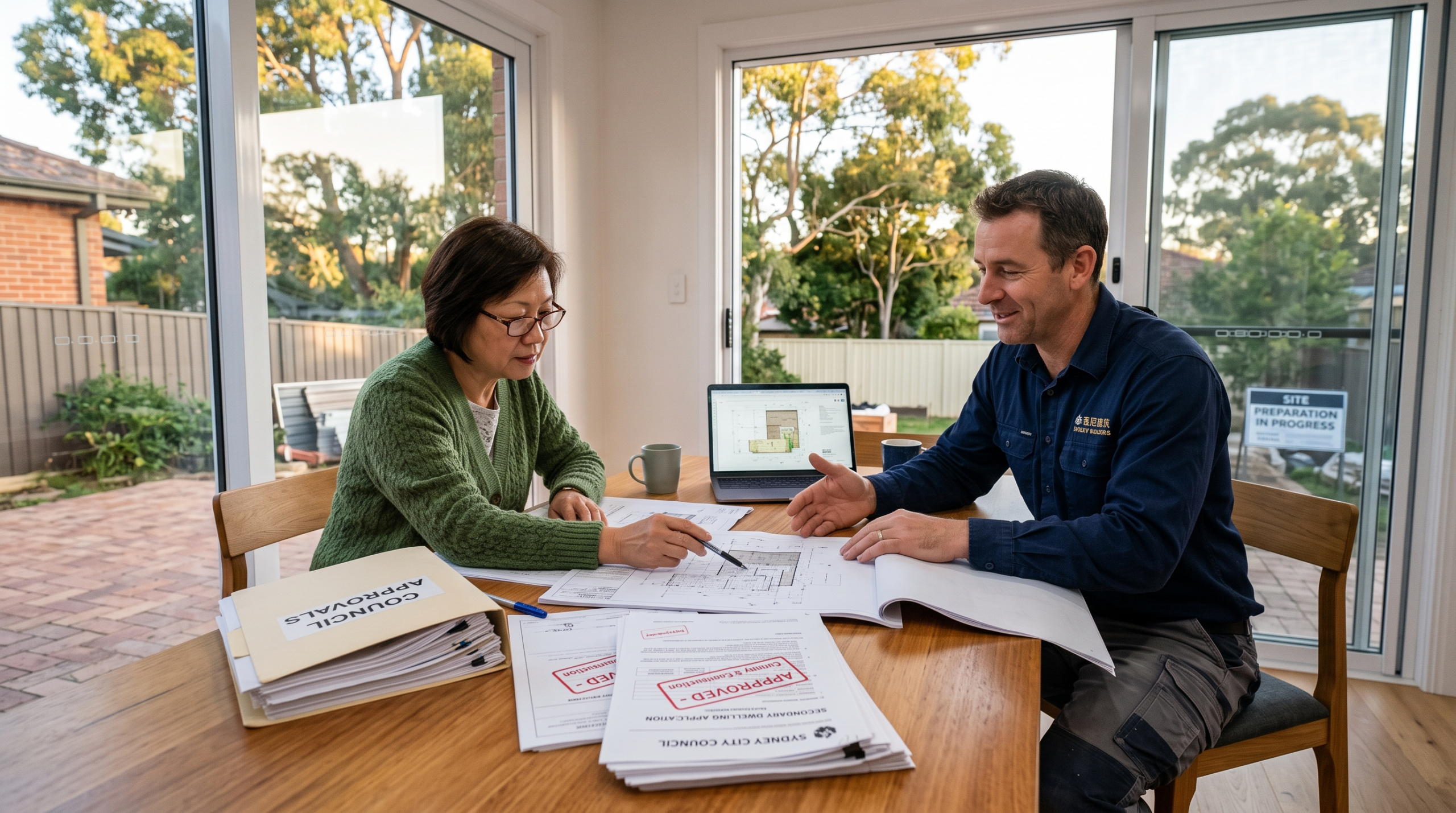
Granny Flat Approval Process in Sydney: CDC vs DA Explained
Council approval is the step that worries most Sydney homeowners before they even think about design. Will it get knocked back? How long will it take? Which pathway even applies to their block? Understanding the granny flat approval process in Sydney upfront removes most of that uncertainty, because in the vast majority of cases, your property will qualify for one of two clear pathways: a Complying Development Certificate (CDC) or a Development Application (DA).
Here’s how each pathway works, how to tell which one applies to you, and what to expect along the way.
Two Paths to Approval: CDC and DA
Complying Development Certificate (CDC)
A CDC is the fast-track option. If your property meets a set of fixed planning rules, a private certifier can approve your granny flat without it going to council at all. That means fewer delays, lower holding costs, and a far more predictable timeline.
Development Application (DA)
If your property doesn’t meet every CDC requirement — for example, due to a heritage overlay, bushfire or flood risk, or a non-standard lot shape — your granny flat is approved through a DA instead. A DA is lodged with your local council, and because each council has its own Development Control Plan (DCP), the specific rules can vary from one local government area to the next.
Neither pathway is better or worse — they simply apply to different sites. A CDC is faster when your property qualifies; a DA is the correct (and only) route when it doesn’t.
Site Eligibility: Does Your Property Qualify for a CDC?
Whether a CDC pathway is available comes down to your lot size, frontage, and how much of the site your home and granny flat will cover. As a general guide across NSW:
- 450–600m² lots need a minimum 12m frontage, can cover up to 50% of the site, and allow up to 330m² of total floor area, with an 8.5m height limit and at least 20% landscaped area.
- 600–900m² lots follow similar frontage and coverage rules but allow up to 380m² of total floor area and require 25% landscaping.
- 900–1,500m² lots need a wider 15m frontage, reduce maximum site coverage to 40%, and require larger setbacks (6.5m front, 1.5m side, 5m rear).
- 1,500m²+ lots require an 18m frontage, drop site coverage to 30%, and call for generous setbacks (10m front, 2.5m side, 10m rear) with 45% landscaping.
On top of this, every CDC granny flat is capped at 60m² of floor area, needs a 24m² courtyard at least 4m wide, and is limited to one granny flat per lot. Battle-axe blocks also need an access handle at least 3m wide. If your site ticks these boxes, a CDC is usually the quickest way to approval.
See how our team assesses site eligibility during design.
Documents You’ll Need at Tender Stage
Whichever pathway applies, a few documents are typically reviewed before a fixed-price tender can be finalised:
- Section 10.7 Planning Certificate — a snapshot of the zoning and planning controls that apply to your property.
- Certificate of Title — confirms legal ownership and flags any easements that could affect the build.
- Sewer Service Diagram — shows the location of existing wastewater pipes, which can influence where a granny flat can sit on the block.
Having these ready early avoids back-and-forth later and helps your builder give you an accurate, fixed-price quote from the start.
How Approval Fits Into the Build Timeline
At The Granny Flat Experts, approval is built into a structured three-step process so you always know what’s happening next:
- Free Site Assessment & Fixed Price Tender — we assess your site’s eligibility and provide a tender proposal with no obligation.
- Design, Approval & Colour Selections — typically 6–8 weeks, covering your Home Building Contract and showroom colour and finish selections while approval is finalised.
- Construction & Handover — typically 18–20 weeks, including a pre-construction meeting with your Site Supervisor and a final walkthrough.
Because approval and design happen together rather than as separate, disconnected steps, there’s far less chance of surprises once construction begins.
Reducing Approval Risk
The biggest fear most homeowners have isn’t the approval process itself — it’s committing money and then finding out their site doesn’t qualify. That’s why our free site assessment comes first, before any design fees are charged, and why we back it with an Approval Guarantee: if we can’t get your granny flat approved after that assessment, it’s a full refund.
Explore floor plans designed around approval requirements.
Frequently Asked Questions
How long does each approval pathway take?
A CDC is generally the faster option because a private certifier can approve it without council involvement, often within a matter of weeks once documentation is complete. A DA depends on your local council’s processing times and can take considerably longer, since it’s assessed against that council’s own Development Control Plan.
Do I need my neighbours’ consent?
Not usually. Most CDC and DA granny flat approvals don’t require neighbour sign-off, though notification requirements can vary by council for a DA. Your builder or certifier can confirm what applies to your specific site.
Can I build a granny flat on a heritage-listed or flood-affected property?
Possibly, but it will usually need to go through a DA rather than a CDC, since these conditions typically fall outside the standard CDC criteria. A site assessment will confirm exactly what’s required.
What happens if my property doesn’t qualify at all?
This is rare, but if a free site assessment finds your property can’t be approved for a granny flat, an Approval Guarantee should mean you aren’t out of pocket for simply finding that out.
Start With a Free Site Assessment
The fastest way to find out whether your property qualifies for a CDC, or needs a DA, is to have it properly assessed. At The Granny Flat Experts, that assessment is free, obligation-free, and the first step in a fixed-price tender — and for a limited time, new clients can also access $10,000 worth of upgrade inclusions for just $4,900 on a standard 60m² granny flat.