
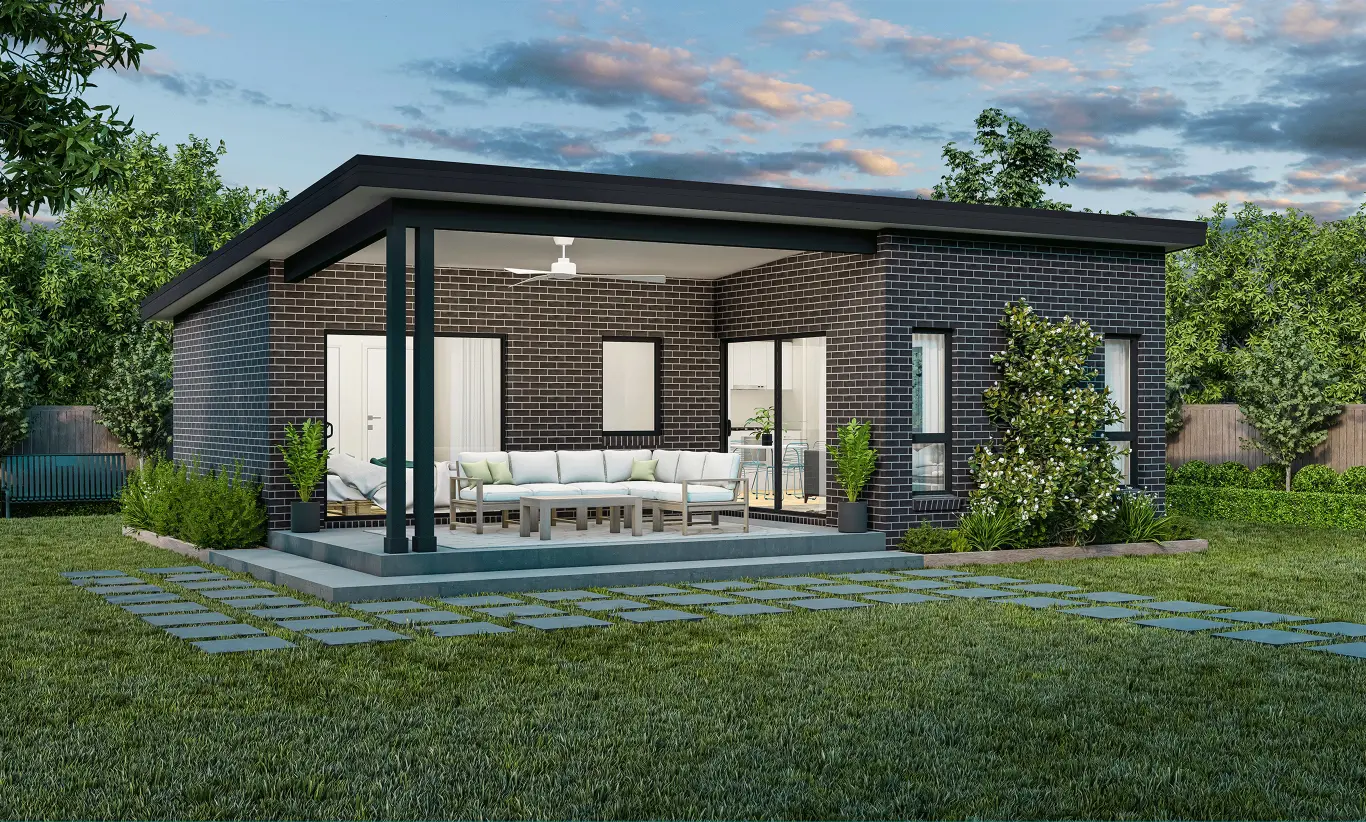
Planning the ideal granny flat design is a bit like crafting a cocktail – you blend space, style and smarts. Picture your spare backyard morphing into a sleek mini-home: you’ve got you and I chatting under pergolas, while the kids build LEGO nearby. These days, granny flats (aka backyard studios or secondary dwellings) aren’t your grandma’s shoddy old annex.
In Sydney, they’ve gone upscale – with open layouts, smart tech, and even solar panels. Whether you’re thinking multi-gen living, extra rental income, or simply a cool hangout space, let’s dive into making your granny-flat dream oh-so-perfect.
First off, know this: a granny flat must be self-contained (kitchen, bath, living – all in). By NSW rules, they’re allowed only in residential zones (R1–R5) and you can only have one granny flat per lot.
Think of it as a “house within a house” on the same land. You also can’t slice your property in half – the granny flat stays tied to the main home. This keeps Sydney’s suburbs from turning into mini-apartment jungles.
Navigating Sydney’s Granny Flat Regulations
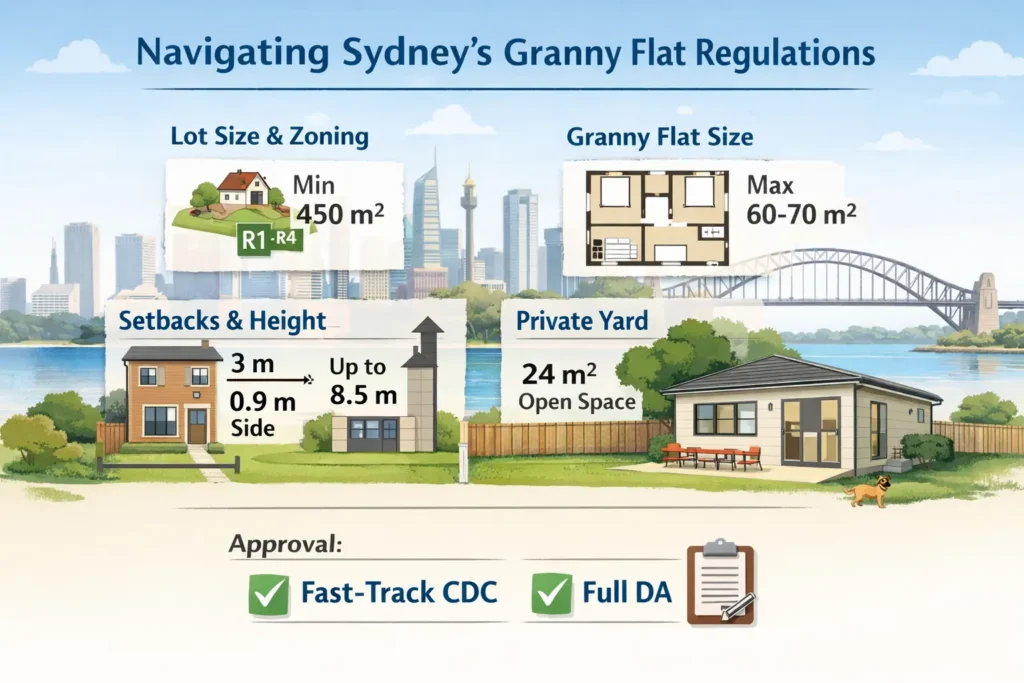
Before sketching that floor plan, let’s tackle the fine print. In NSW (that’s Sydney’s state), the Housing SEPP 2021 is your bible for granny flats. In plain talk, here’s what you need:
- Lot Size & Zoning: Your block must be at least 450 m² and zoned residential (R1–R4). For example, most Sydney homes qualify, but tiny urban blocks might not. If your land is smaller than 450 m², you can still build a granny flat – you just can’t fast-track it as a “Complying Development” (CDC). You’ll have to do a full council approval (DA) instead.
- Granny Flat Size: The indoor living area is capped (to keep it granny-sized). By NSW rules, the maximum is around 60–70 m² for CDCs. That’s cozy but functional: picture a 2‑bed, 1‑bath with an open kitchen. If you’re dreaming bigger (say 80 m²), you may need a full development application.
- Setbacks & Height: Expect at least 3 m from the rear boundary and about 0.9 m from side fences. Height-wise, Granny flats can often be up to 8.5 m tall (plenty for a single storey with high ceilings or even a low-profile second storey). You’ll also need a little private yard: roughly 24 m² of open space with a 4 m clear width (think a modest patio or yard where your pet can roam).
- Permission: Good news – NSW lets you apply together for the house and granny flat gesign under one CDC if all rules are met. That can save time. Otherwise, you’ll lodge a Development Application (DA) with your local council.
In short, if you tick all those boxes, you can often get a simple CDC (a light-touch approval) and build fast. If not, a DA is the way. Either way, it’s smart to chat with a town planner or council early so you don’t hit surprises later.
Designing Your Dream Granny Flat
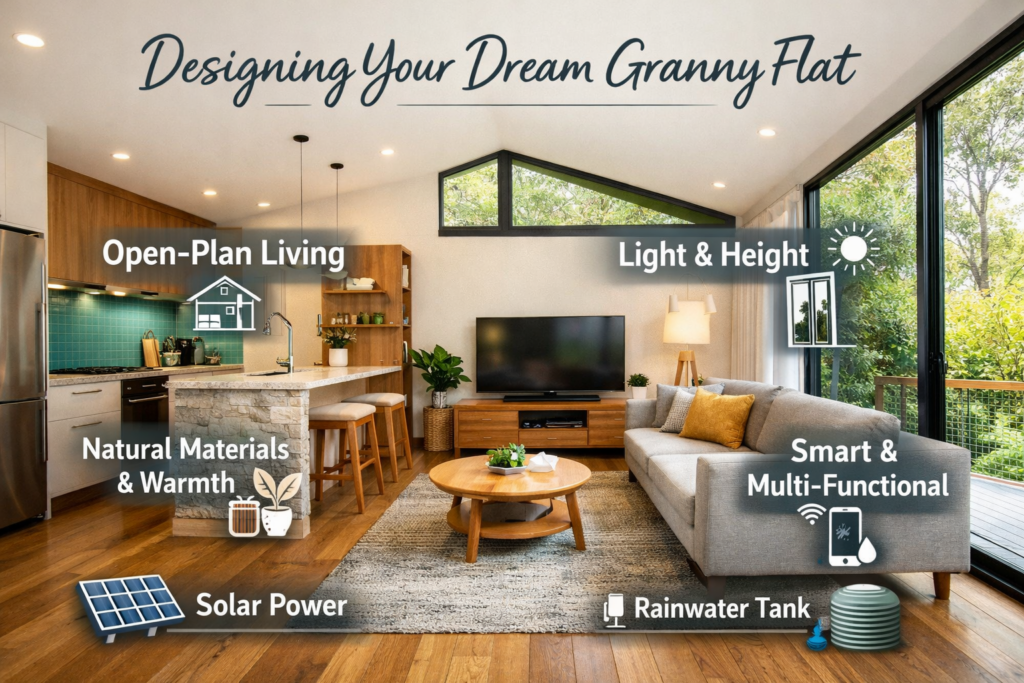
Okay, rules noted – now the fun part. What will your granny flat look like and feel like? These days, even small spaces are BIG on style:
- Open-plan living: Smash down that hallway! Modern granny flats love one-room flow. Open-plan kitchens that spill into living rooms make a compact space feel light and airy. For example, a Parramatta family wanted a 2-bed granny flat that felt spacious. The designers used smooth walls and continuous tile floors so the kitchen, dining and lounge meld together seamlessly. That kind of layout helps a modest floorplan feel like a generous loft.
- Light and height: High ceilings and big windows are a godsend in a little home. In Sydney’s Hills District, one cute two-pavilion granny flat was built off to the side of the main house. Though modest in footprint, its architect gave it high raked ceilings and floor-to-ceiling windows, making every corner open to the bushland view. Suddenly, the “shoebox” feels airy and connected to nature.
- Natural materials and warmth: Hard surfaces + cozy accents = chic balance. Consider timber floorboards or stone benchtops to bring warmth. (PS: Concrete floors + a snuggly rug = hygge on a budget.) And don’t shy from a splash of colour – maybe a feature wall or a tile backsplash in the kitchen to make it pop without clutter.
- Multi-purpose spaces: Your granny flat (especially in a city backyard) has to work hard. Think built-in wardrobes, fold-down desks or Murphy beds. A study corner that folds into a guest nook, or a TV entertainment unit that hides storage, can be life-savers in a 50 m² pad.
- Smart home tech: Yes, install dimmable LEDs, a smart thermostat, maybe even app-controlled blinds. These little touches not only wow visitors but truly make living easier. Imagine adjusting your granny flat AC from your phone while stuck in traffic – it’s that level of convenience.
- Building trends are catching up: architects in Sydney now treat granny flats like mini-design showcases. In that Hills District pavilion project, recycled bricks and steel cladding weren’t just eco-picks – they looked cool and met bushfire codes.
Solar panels and rainwater tanks topped it off, giving the couple a tiny home with a tiny carbon footprint. As the architect notes, the granny flat trend is booming thanks to housing shortages and multigenerational living – basically, more us under one roof, just with separate keys.
Sustainability and Materials
Think of your granny flat as a testbed for green living (and it is 2026, after all). Go for well-insulated walls and double-glazed windows – these keep summer heat out and winter warmth in, saving on bills.
Even finishing touches can shout eco-smarts: bamboo flooring, LED lights, low-VOC paint, or even recycled timber panelling for a feature wall. Many Aussie builders now offer NCC 6-star energy compliance as standard on these units.
Rainwater tanks for garden/loo flushing? Absolutely. Check if your area gets plenty of sun – solar hot water or panels on the flat roof could pay for themselves in a few years. It’s not just tree-hugging; greener builds often win design awards and impress buyers/renters. Plus, you’ll sleep better at night knowing your granny flat isn’t just stylish, it’s sensible too.
Budgeting and Cost Estimates
Alright – the elephant in the backyard: how much will all this cost? There’s no flat fee (get it?), but ballpark: basic 1‑bed granny flats (30–40 m²) start around $80–$120K if you stick to standard finishes. A mid-range 2‑bed flat (40–60 m²) will run $120–$160K or more.
Go full luxury (high-end kitchen, extra room, custom features) and $200K+ is on the table. In Sydney’s competitive market, builders often quote on the higher side of these ranges.
For example, national surveys show a 36 m² one-bed costs roughly $80K–$130K. A 60 m² two-bed lands at $110K–$160K. In table form:
| Size & Bedrooms | Approx. Cost (AUD) |
| 30–40 m², 1 bed | $80,000 – $130,000 |
| 40–60 m², 2 beds | $110,000 – $160,000 |
| 60–80 m², 2–3 beds | $150,000 – $200,000 |
Remember: these are build costs (including construction, finishes, and basic fixtures). Factor in extra for approvals, architect/engineer fees, utility connections and landscaping. If your site needs major prep (rocky soil, retaining walls, narrow access), add contingency. And keep in mind Sydney land costs and labor rates have been creeping up, so lock in quotes early.
Building a granny flat can boost property value and rental income. Allocate extra budget for high-quality finishes if you want long-term returns (vs. going ultra-budget).
Return on Investment
Speaking of value – a granny flat can pay off big time. Investors often see 10–20% rental yields on a well-located backyard cottage. Imagine your $180K spend earning $500–$600/week in rent – that’s an automatic boost to your cash flow. And it’s not just rent: studies show adding a two-bedroom granny flat can lift your home’s sale price by roughly 30–32%. Essentially, you’re creating a mini second house that can rent or sell later.
For context, Sydney has hundreds of thousands of properties that could add an ADU. The crunch is on space; so unique, well-designed granny flats stand out.
Even from a purely financial lens, tapping this hidden land value is savvy: borrow against existing equity (banks often allow up to 95% of the granny flat’s value), then let tenants or family cover the loan. This isn’t speculation – it’s real estate strategy.
Working with the Pros & Next Steps
By now you might be itching for that first sketch. Here’s the smart play:
- Talk to your council or a town planner: Even if you’re confident, give your local council a quick call or online enquiry. Double-check zoning, bushfire rules, heritage overlays, etc. They can flag if any special rules apply to your Sydney suburb.
- Hire an architect or designer: A good architect (many specialize in small homes) will turn your vague ideas into solid plans and help with the DA/CDC paperwork. They’ll also optimize your granny flat’s orientation for sun, flow and privacy. Plus, you get professional advice on what fits the rules (and your budget!).
- Get multiple builder quotes: Contact at least 2–3 licensed granny-flat builders or builders with ADU experience. Look at their previous Sydney projects and reviews. A quote is usually “turn-key” so check exactly what’s included (flooring, appliances, etc).
- Plan utilities & connections: Ensure you factor in extra costs for plumbing/electrical runs, sewer or stormwater connections. If your block is old, you might need to update service pits or meters.
- Consider financing: Talk to your mortgage broker/bank about a construction loan or using equity. Granny flats often qualify for that sweet construction loan (sometimes interest-only during build).
- Stay local for insights: Visit a display granny flat if you can, or tour a friend’s project. Pinterest and Houzz have plenty of Aussie backyard home tours. Seeing real examples of material combinations and space usage can spark ideas you hadn’t thought of.
Throughout, keep your vision personal: will this granny flat be a luxe retreat, a cozy studio or a split lounge/bedroom design? Do you fancy an Aussie-Scandi vibe with white interiors, or a minimalist Japanese touch? Whatever your choice, the key is coherence and functionality. A well-planned granny flat not only feels like home – it feels like you.
Conclusion
Planning the perfect granny flat design in Sydney means marrying local know-how with a dash of creativity—especially when working with The Granny Flat Experts. Start by ticking off the must-dos (zoning, size, approvals) so nothing trips you up.
Then let your imagination run wild on the could-dos: open-plan layouts, eco-features, smart gadgets, and that perfect backyard vibe. The result? A valuable, versatile space that keeps your family close (or brings in extra income) without crowding your home.
Ready to turn your granny flat concept into reality? Connect with a qualified designer or builder today and unlock your backyard’s full potential.
Frequently Asked Questions
Q1: Can I just build a granny flat without council approval in Sydney?
A: Generally no. Even if you meet all the CDC standards, you need a Complying Development Certificate (CDC) or DA. However, if you’re rebuilding or building both a house and granny flat together, you can often get one CDC for both. Always lodge the paperwork; an “illegal” build can cause big headaches (fines, forced removal).
Q2: What’s the maximum size for a granny flat in NSW?
A: For a CDC pathway, internal living areas are capped at around 60–65 m² (plus verandahs, decks). Some councils might allow up to 70 m². If you want larger, you’d need a full DA. Note: attic or mezzanine floors often count in these limits.
Q3: How long does it take to build a granny flat in Sydney?
A: Once approvals are in hand, construction is relatively quick – often 8–12 weeks for a simple one-bedroom unit. A designer granny flat might take a bit longer. The approval stage (CDC vs DA) can vary: CDC is faster (weeks), DA can take a few months if there’s assessment.
Q4: Can I rent out my granny flat?
A: Yes! Granny flats are often rented to generate income. NSW rules allow renting out secondary dwellings. Just ensure you follow fire safety (smoke alarms, egress) and let your insurer/bank know you have a rental.
Q5: Is a granny flat a good investment in Sydney right now?
A: For many homeowners, yes – especially given Sydney’s housing crunch. The rental market is strong, and adding an extra dwelling can boost your property’s value substantially. Plus, it’s a way to future-proof living arrangements (think aging parents or adult kids). Crunch the numbers with your local market rents and you’ll likely see why so many Sydneysiders are planning their perfect granny flat.